The domestic new energy vehicle market is developing rapidly, and some small companies have already ceased operations due to poor management. However, market competition remains fierce, and any slight change in the new energy market can stir up a commotion. Recently, one topic has been the claim that a "Evergrande of the auto industry" has already appeared in China. Based on this remark, some people associate it with BYD, whose sales scale has been growing rapidly. But from the current perspective, perhaps an Evergrande in the auto industry does exist, yet judging from sales data, the financial report data published by BYD, and its later product planning, this so-called Evergrande in the auto industry should refer to someone else. Especially some new car-making forces with a shallow foundation and low sales. Whenever sales fail to meet expectations for a period of time and funding does not arrive, they directly enter a state of shock and are not far from closing down.
Regarding this issue, Li Yunfei, who is responsible for BYD's public relations department, also posted a long Weibo post, which can be regarded as a direct response to some remarks on the market. From the content of the Weibo post, in terms of sales data and financial report data, BYD is in a stage of healthy and sound growth.
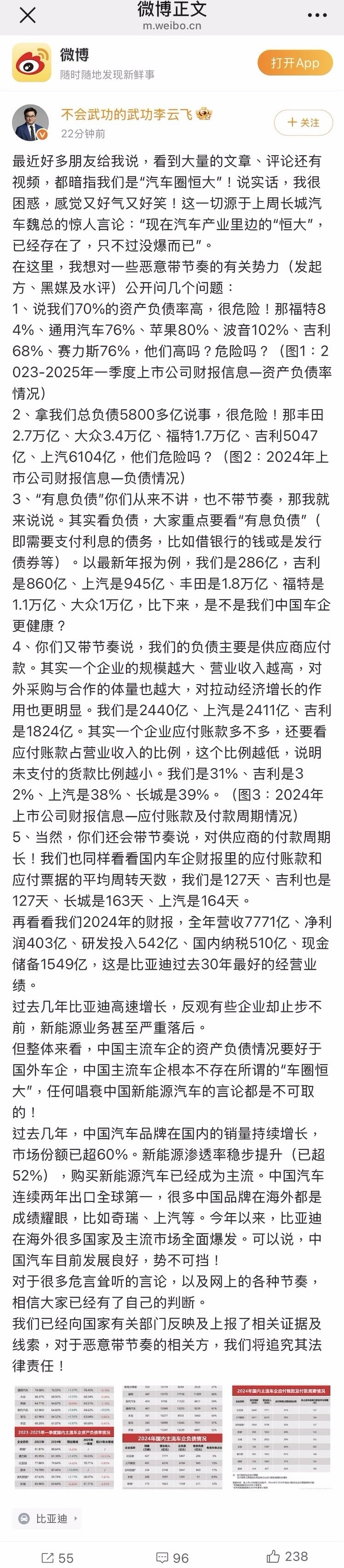
In subsequent forwarding and comments, he also said, "We will still continue to insist on: large investment in research and development, further technological innovation, and focusing on doing our own things well!"
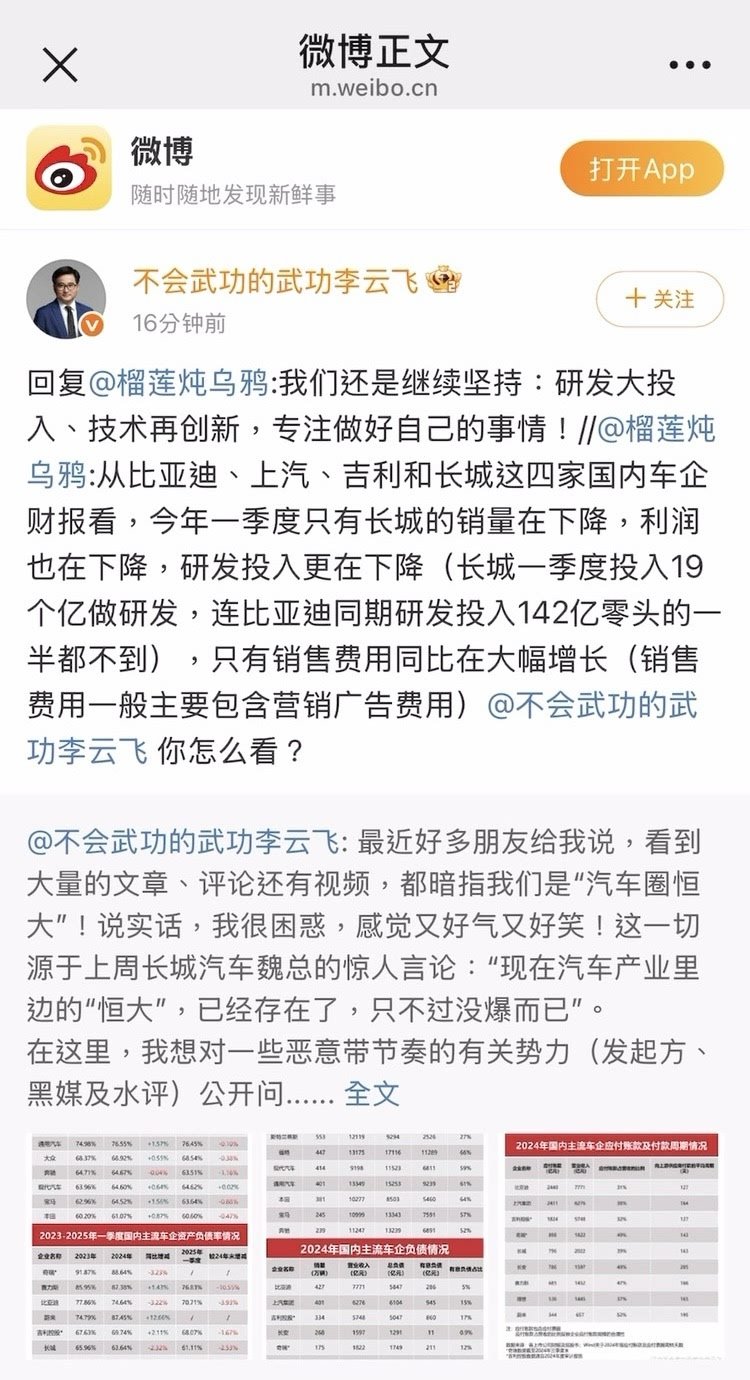
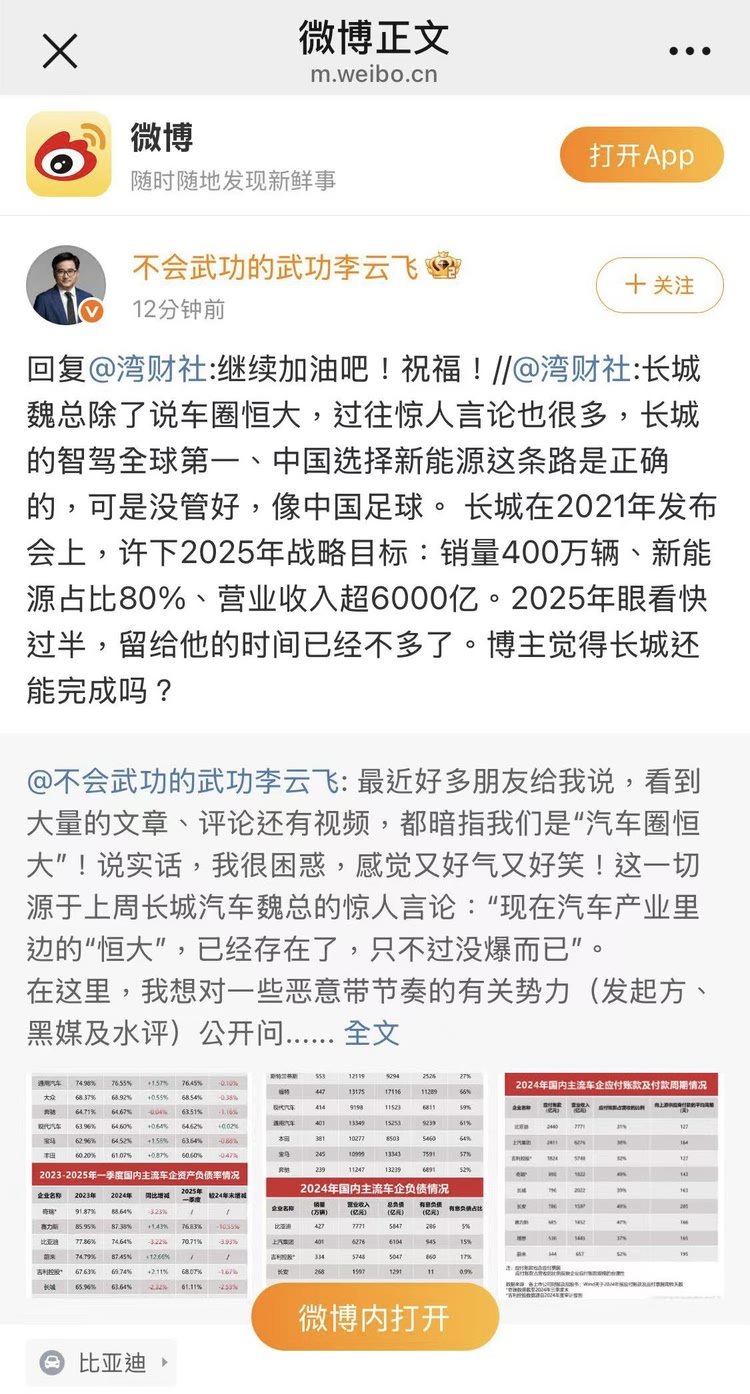
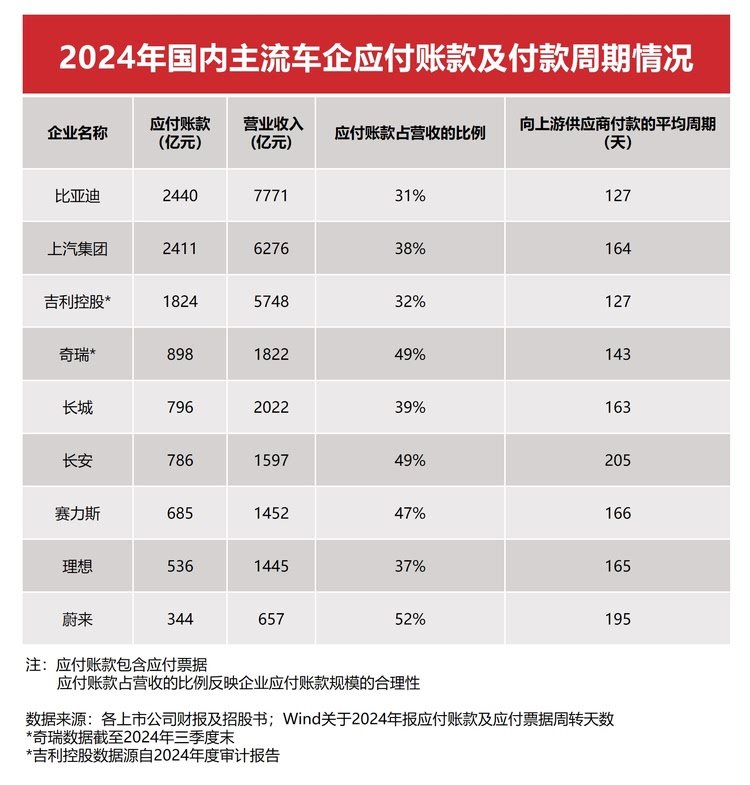
Therefore, it can be foreseen that BYD will still have a series of new moves in technological research and development and new products in the future. In addition, in the Weibo post, he also shared three charts showing the debt, accounts payable cycle, and debt ratio of mainstream domestic and international automakers in recent years. They are very valuable for reference. In particular, one point is that BYD's payment cycle of 127 days is lower than that of many domestic automakers. On the other hand, BYD's debt ratio this year has decreased by 3.93 percentage points compared with last year.
In addition, from the tables we can also derive a lot of valuable information. From the 2024 financial reports, total liabilities are related to enterprise scale and revenue. Whether it is international automotive giants such as General Motors, Volkswagen, Mercedes-Benz, and Toyota, or leading domestic automakers such as BYD, Geely, SAIC, and Changan, their asset-liability ratios are mostly above 60%. However, against the broader backdrop of generally high debt ratios, domestic and international automakers show different trends of change. The asset-liability ratios of leading domestic automakers have declined significantly, and their advantages are gradually becoming prominent. Among them, BYD's performance is especially outstanding, with its debt ratio falling by nearly seven percentage points in the past half year, already down to 70.7%. Based on the current trend, the debt ratio is expected to fall to the "6" range within this year.
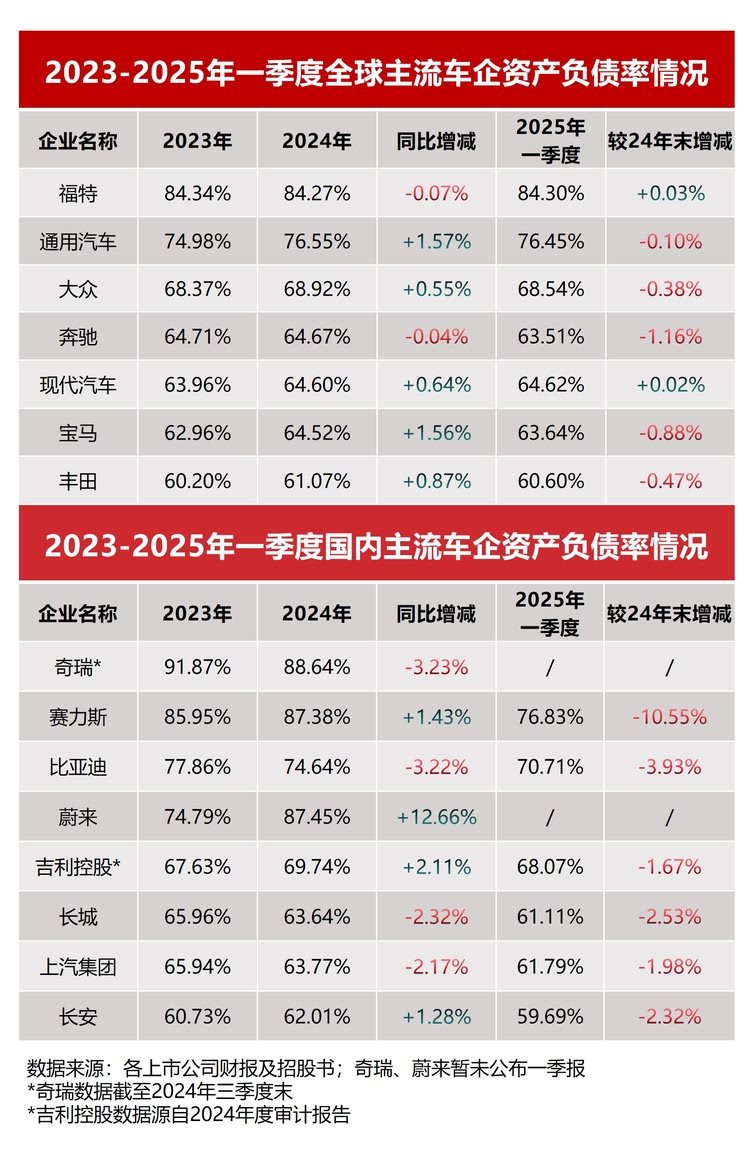
In addition, judging from the financial report data, the debt ratios of overseas traditional automakers are generally high, and some companies' debt levels are still climbing. Taking Ford and General Motors as examples, their asset-liability ratios in 2024 reached 84.27% and 76.55% respectively, and the proportion of interest-bearing liabilities was as high as 66% and 61%. The total liabilities of giants such as Volkswagen and Toyota even exceeded their revenue in the same period, reflecting the heavy funding pressure they face in the process of electrification transformation.
By contrast, Chinese automakers delivered a remarkable report card in 2024. As a typical representative, BYD not only saw sales exceed 4.27 million vehicles, comparable in scale to Ford and General Motors, but its debt structure is also significantly better than that of its international peers. BYD's asset-liability ratio dropped from 77.86% in 2023 to 74.64% in 2024, and further fell to 70.7% in the first quarter of 2025, demonstrating strong financial optimization capability.
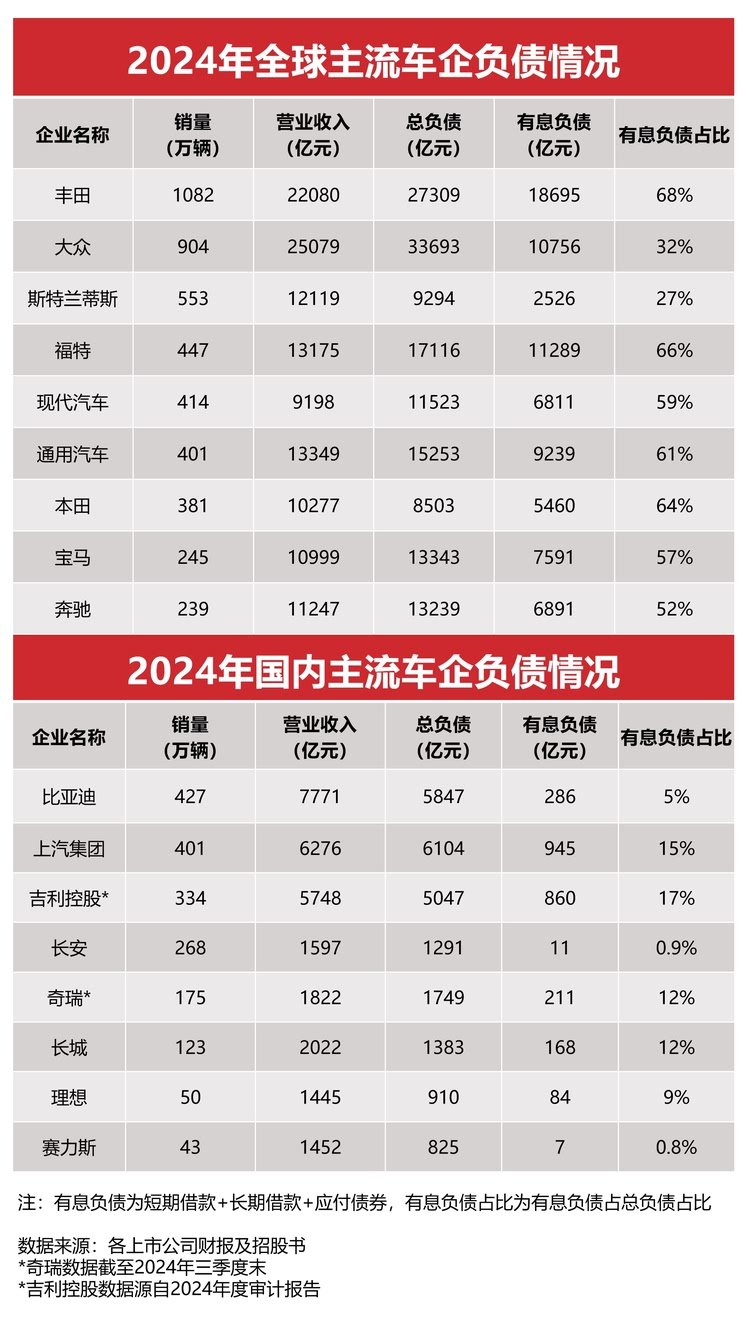
Unlike overseas automakers, Chinese automakers generally have a lower dependence on interest-bearing liabilities. BYD's interest-bearing liabilities account for only 5% of total liabilities, far lower than Toyota's 68% and Ford's 66%. This low-leverage operating model gives Chinese automakers more advantages in debt repayment pressure and liquidity management.
Therefore, from the 2024 global automaker financial reports, it can be seen that Chinese automakers are winning the initiative in this industry transformation with a healthier financial structure and more efficient operating capabilities. Of course, challenges still remain. Chinese automakers need to continuously strengthen core technology research and development, expand into international markets, and at the same time continue to maintain financial prudence, so as to remain invincible in future competition.